Humidifier Safe for Infants? 7 Rules for Baby Rooms
Dadfficient is reader-supported. If you buy through my links, I may earn a commission at no extra cost to you. I only recommend gear that passes the “Dad Test.”
Humidifier safe for infants? Yes—a humidifier can be used safely in a baby’s room when you choose a cool-mist model, keep the unit and cord out of reach, clean it regularly, and keep room humidity in a moderate range.
The humidifier itself is only part of the system. Water quality, cleaning habits, placement, and humidity control matter just as much as the machine you buy.
For most nurseries, the goal is simple: use cool mist, keep relative humidity around 30% to 50%, prevent condensation, change the water regularly, and keep the humidifier well away from the baby’s reach.
Quick Dad Verdict: 7 Rules
- Use cool mist: It avoids the hot-water and steam burn risk associated with warm-mist units.
- Keep it out of reach: The humidifier and power cord should be positioned so the baby cannot touch or pull them.
- Target 30% to 50% RH: Use a hygrometer and reduce output if you see condensation.
- Change water and clean regularly: Do not let stagnant water sit in the tank for long periods.
- Use lower-mineral water when practical: Distilled water can reduce mineral buildup and white dust in ultrasonic models.
- Skip unapproved additives: Do not put oils, medications, or vapor products into the tank unless the manufacturer specifically allows them and your child’s clinician recommends them.
- Watch the room, not just the machine: Damp walls, bedding, windows, worsening cough, or leaks mean the setup needs to change.
Is a Humidifier Safe for Infants?
A humidifier safe for infants is less about finding one magical machine and more about using the right type of humidifier correctly.
Cool-mist humidifiers are generally considered the safer choice around babies and young children because they do not contain boiling water or release hot steam that can cause burns.
That does not mean a cool-mist humidifier can simply be filled and forgotten.
A poorly maintained humidifier can collect mineral deposits, bacteria, or mold, while excessive room humidity can encourage condensation and dampness.
The safest setup combines the right humidifier with good cleaning habits and actual humidity monitoring.
If congestion is the reason you are setting up the humidifier, see our
How to Use a Humidifier for Baby Congestion
guide for the practical setup.
Rule 1: Use Cool Mist Around Babies and Young Children
When choosing a humidifier for a nursery, cool mist is the safer default.
Warm-mist humidifiers and vaporizers heat water to create steam. That introduces a burn risk if the child touches the unit, reaches the steam, or pulls the machine over.
Cool-mist units avoid that particular hazard while still adding moisture to dry indoor air.
Both ultrasonic and evaporative humidifiers can provide cool mist or cool humidification, but they handle water minerals differently.
Rule 2: Keep the Humidifier and Cord Out of Reach
A humidifier filled with water is heavier than it looks, and the power cord can create an additional hazard around a crib.
Keep both the unit and cord completely outside the baby’s reach.
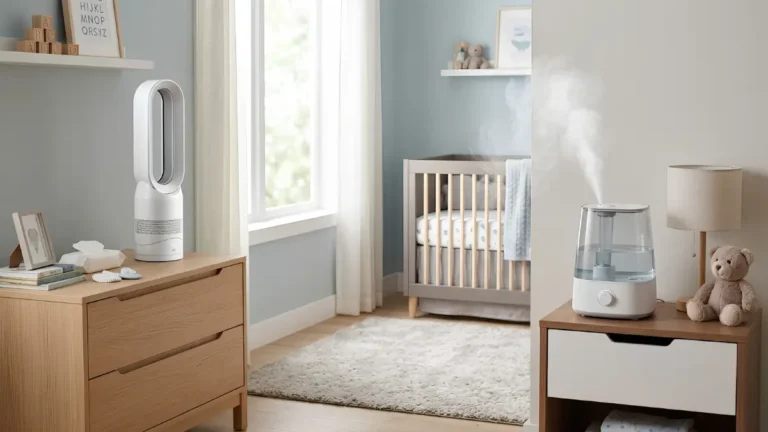
For crib and cord safety, using at least a three-foot separation from the sleep area is a useful conservative rule when possible.
You do not need to crowd the humidifier beside the crib for it to work. The goal is to humidify the room, not direct a stream of mist at the baby.
For the full placement layout, see:
Where to Place Humidifier in Baby Room: 3 Safe Spots.
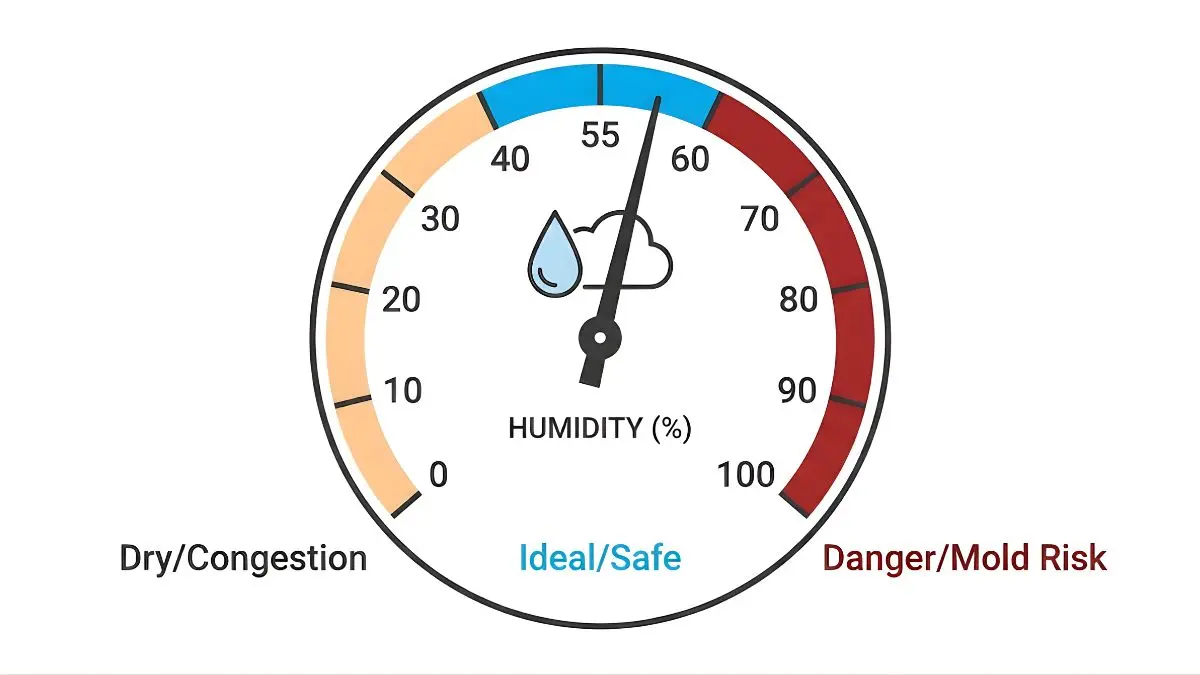
Rule 3: Keep Nursery Humidity Around 30% to 50%
More humidity is not automatically better.
The EPA recommends keeping indoor relative humidity in a moderate range, generally around 30% to 50%.
If the room becomes too humid, you may start seeing condensation on windows, walls, or nearby furniture.
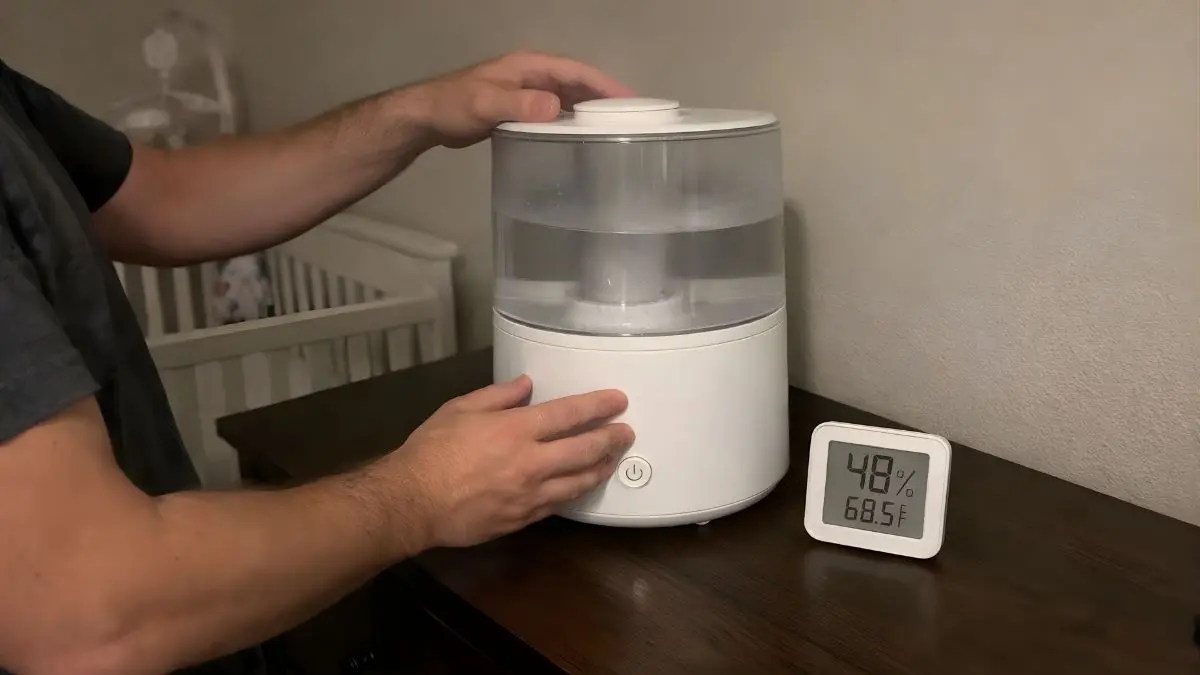
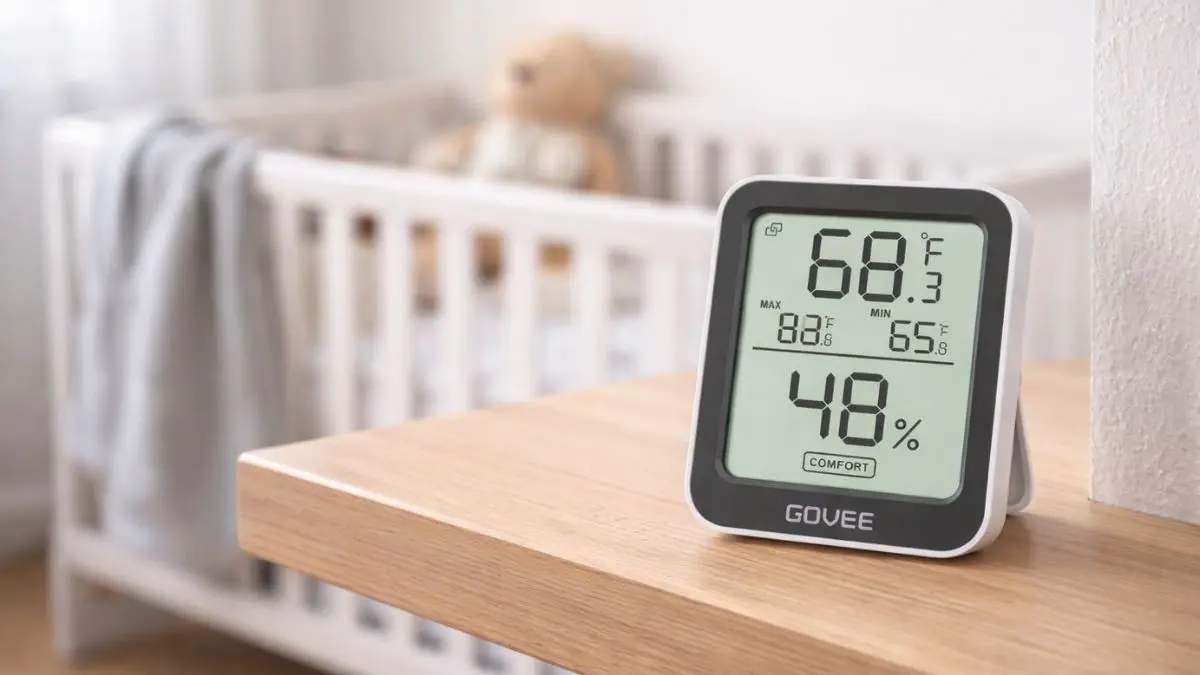
A small digital hygrometer is one of the easiest ways to verify what is actually happening in the nursery.
If your humidifier already has a built-in humidity sensor, an independent hygrometer can still be useful as a second reference point elsewhere in the room.
Rule 4: Change the Water and Clean the Humidifier Regularly
Standing water and dirty water-contact surfaces are two of the biggest maintenance problems with portable humidifiers.
Do not continuously top off old water.
Empty the tank regularly, allow water-contact surfaces to dry when appropriate, and follow the manufacturer’s cleaning schedule for your specific model.
The EPA recommends frequent maintenance of portable humidifiers, including replacing water daily and cleaning the unit regularly.
If you see visible film, discoloration, slime, or mineral buildup, stop using the humidifier until it has been properly cleaned.
For a deeper cleaning walkthrough, see:
How to Clean a Humidifier With Hydrogen Peroxide.
Rule 5: Use Lower-Mineral Water When Practical
Water choice matters most with ultrasonic humidifiers.
Ultrasonic models create very fine water droplets. If the water contains a lot of dissolved minerals, some of those minerals can be dispersed into the room as white dust.
The EPA recommends using water with lower mineral content, such as distilled water, when practical to reduce mineral deposits and dispersal.
The White Dust Issue
White dust is not automatically a medical emergency, but it is a sign that minerals from the water are being dispersed into the room.
If you see white residue collecting on furniture or around the crib, switch to lower-mineral water or consider an evaporative humidifier.
For more detail, read:
Is Humidifier White Dust Harmful?.
Rule 6: Do Not Add Oils or Medications Unless Specifically Approved
Do not assume that a humidifier tank can safely hold essential oils, vapor liquids, medications, or fragrance products.
Many humidifiers are designed for water only.
Adding other substances can damage internal components, leave residue, or release substances into the air in ways the machine was not designed to handle.
If your humidifier has a dedicated aroma tray, medicine cup, or other manufacturer-approved feature, follow the instructions for that specific model.
For infants and young children, discuss medicated or scented vapor products with your child’s pediatrician or pharmacist before use.
Rule 7: Watch for Condensation, Leaks, or Worsening Symptoms
The nursery itself tells you when the setup needs adjustment.
Reduce the humidifier output or move the machine if you notice:
- condensation on windows
- damp walls or curtains
- wet bedding
- water collecting around the humidifier
- persistent musty odors
- visible mold or mildew
If your baby’s cough or breathing symptoms seem to get worse when the humidifier is running, stop using it and reassess the machine, water, cleaning routine, and room humidity.
For persistent breathing problems, wheezing, difficulty breathing, fever in a young infant, dehydration, or symptoms that concern you, contact your child’s healthcare professional rather than relying on the humidifier as treatment.
Using a Humidifier for Newborn Congestion
Using a humidifier for newborn congestion may help make dry indoor air more comfortable and can help with dry nasal passages when a baby has a cold.
A humidifier does not cure the infection itself.
The goal is simply to keep the air from becoming excessively dry while you use other age-appropriate congestion measures recommended by your child’s clinician.
Cool-mist humidification may be especially useful during heating season when indoor air becomes dry.
If your newborn is having difficulty feeding or breathing because of congestion, contact the baby’s pediatrician rather than increasing the humidifier output beyond normal room-humidity levels.
Humidifier for Baby Cough and Cold: What It Can and Cannot Do
A humidifier for baby cough and cold symptoms is a comfort tool, not a medication.
It may help relieve dryness and make breathing feel more comfortable when indoor air is dry.
It cannot treat pneumonia, bronchiolitis, asthma, RSV, influenza, or another underlying respiratory illness.
If coughing becomes worse around humidifier use, check for excessive room humidity, dirty water, mineral dispersal, or visible contamination inside the machine.
Our
Humidifier Causing Cough Guide
covers those troubleshooting steps.
Where to Place Humidifier for Baby
When deciding where to place humidifier for baby safety, focus on four things:
- Reach: Keep the machine and power cord completely out of the child’s reach.
- Stability: Use a hard, flat, stable, water-resistant surface.
- Mist direction: Aim mist toward open room air rather than directly at the crib, wall, curtains, or electronics.
- Moisture: Reduce output if nearby surfaces become damp.
Do not overcomplicate this section here—the dedicated placement guide covers the three nursery layouts in detail:
Where to Place Humidifier in Baby Room.
Air Purifier and Humidifier in the Same Nursery
Ultrasonic humidifiers can sometimes affect optical particle sensors used by air purifiers.
The purifier may temporarily interpret very fine water droplets or mineral particles as airborne particulate matter.
If your purifier suddenly reports poor air quality whenever the humidifier starts, increase the distance between the two devices and avoid directing mist toward the purifier’s sensor.
Evaporative humidifiers are less likely to create this particular interaction because they do not release visible ultrasonic mist.
For a full setup guide, see:
Baby Air Purifier vs Humidifier.
What Makes a Good Nursery Humidifier?
When choosing a humidifier for a baby room, I prioritize maintenance and safety over flashy features.
Useful features include:
- Cool-mist operation
- Easy-to-clean water-contact surfaces
- Automatic shutoff
- Adjustable mist or humidity controls
- Stable base
- Simple refill design
- Low operating noise
Evaporative designs can also be useful for families who do not want to rely on distilled water to control white dust.
Prefer an Evaporative Humidifier?
Canopy uses evaporative humidification with a replaceable filter designed to reduce minerals and other material from the water before moisture enters the room. Its airflow and drying system is also designed to reduce standing moisture inside the unit.
It is worth considering if white dust and easy daily maintenance are bigger priorities than avoiding replacement filters.
Troubleshooting Your Nursery Humidifier
If you already have a humidifier and something is going wrong, use the specific troubleshooting guide that matches the problem:
-
Levoit red light:
Levoit Humidifier Red Light -
No mist:
Levoit Humidifier Not Misting -
Grinding, squealing, or gurgling:
Vicks Humidifier Making Noise -
Water leaking from the base:
Portable Humidifier Leaking From the Bottom -
Cough gets worse:
Humidifier Causing Cough
Frequently Asked Questions
Is a humidifier safe for infants?
Yes, a humidifier can be used safely for infants when it is cleaned regularly, kept out of reach, used with moderate room humidity, and operated according to the manufacturer’s instructions. Cool-mist models are generally preferred around young children because they avoid hot-water and steam burn risks.
Is using a humidifier for newborn congestion effective?
Using a humidifier for newborn congestion may help relieve dryness and make nasal breathing more comfortable when indoor air is dry. It does not treat the underlying infection, and newborn breathing or feeding problems should be discussed with the baby’s pediatrician.
What kind of humidifier for baby cough and cold should I use?
A cool-mist humidifier is generally the safer option around young children. Choose a model that is easy to clean, keep the room humidity around 30% to 50%, and avoid additives unless the manufacturer specifically allows them and your child’s clinician recommends them.
Where to place humidifier for baby safety?
Place the humidifier on a stable, flat, water-resistant surface completely outside the baby’s reach. Keep the cord safely away from the crib and direct mist toward open room air instead of the baby, bedding, walls, or electronics.
Should a humidifier run all night for a baby?
It can run overnight if the nursery stays in a moderate humidity range and there is no condensation. A hygrometer or built-in humidistat can help prevent over-humidification.
Should I use distilled water in a baby humidifier?
Distilled water is especially useful in ultrasonic humidifiers because it contains fewer minerals than typical tap water and can reduce white dust and mineral buildup. Follow the water recommendations for your specific humidifier model.
-
HealthyChildren.org / American Academy of Pediatrics:
Guidance on humidifiers for children, cool-mist use, congestion relief, and avoiding hot-water or steam burn risks. -
Environmental Protection Agency (EPA):
Guidance on portable humidifier cleaning, water quality, mineral dispersal, and indoor humidity. -
U.S. Consumer Product Safety Commission (CPSC):
Cord-safety guidance for products used around cribs and infant sleep areas.