Where to Place Humidifier in Baby Room: 3 Safe Spots
Dadfficient is reader-supported. If you buy through my links, I may earn a commission at no extra cost to you. I only recommend gear that passes the “Dad Test.”
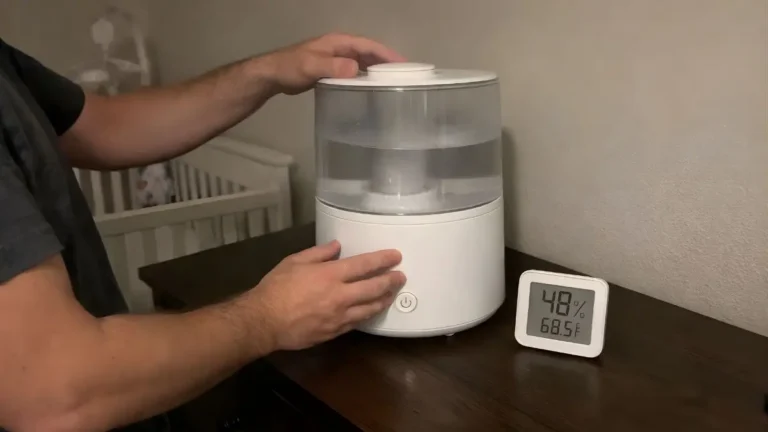
Where to place humidifier in baby room? The best location is on a stable, flat, water-resistant surface that is completely out of your baby’s reach, with the power cord safely routed away from the crib and the mist directed into open room air rather than toward bedding, walls, or electronics.
For most nurseries, that means a dresser, sturdy side table, or stable shelf positioned away from the crib and sleep space.
The goal is not simply to get the humidifier as high as possible. What matters most is stability, cord safety, distance from the child, and preventing nearby surfaces from becoming damp.
Quick Dad Verdict
- Best overall spot: A stable dresser or table positioned away from the crib.
- Cord safety: Keep the humidifier cord completely out of reach and use at least a 3-foot separation from the crib as a conservative cord-safety rule.
- Mist direction: Aim mist toward open room air, not directly at the crib, walls, curtains, furniture, or electronics.
- Surface: Use a hard, level, water-resistant surface rather than carpet, bedding, or a soft towel.
- Humidity target: Keep indoor relative humidity around 30% to 50% and avoid visible condensation.
If you are setting up a baby safe room humidifier, placement is only one part of the job. Cleaning, water quality, humidity monitoring, and choosing the right humidifier type all matter too.
For the complete nursery setup, read our
Humidifier Safe for Infants Guide
.
It covers cleaning, water choice, humidity targets, burn risk, and overnight use.
Where to Place Humidifier in Baby Room: 3 Safe Spots
Every nursery layout is different, but there are three practical locations that work well when you are deciding where to place humidifier in baby room setups.
The right choice depends on your furniture layout, cord routing, and whether the humidifier can operate without wetting nearby surfaces.
1. A Stable Dresser or Table Away From the Crib
For most nurseries, a sturdy dresser or table is the easiest placement option.
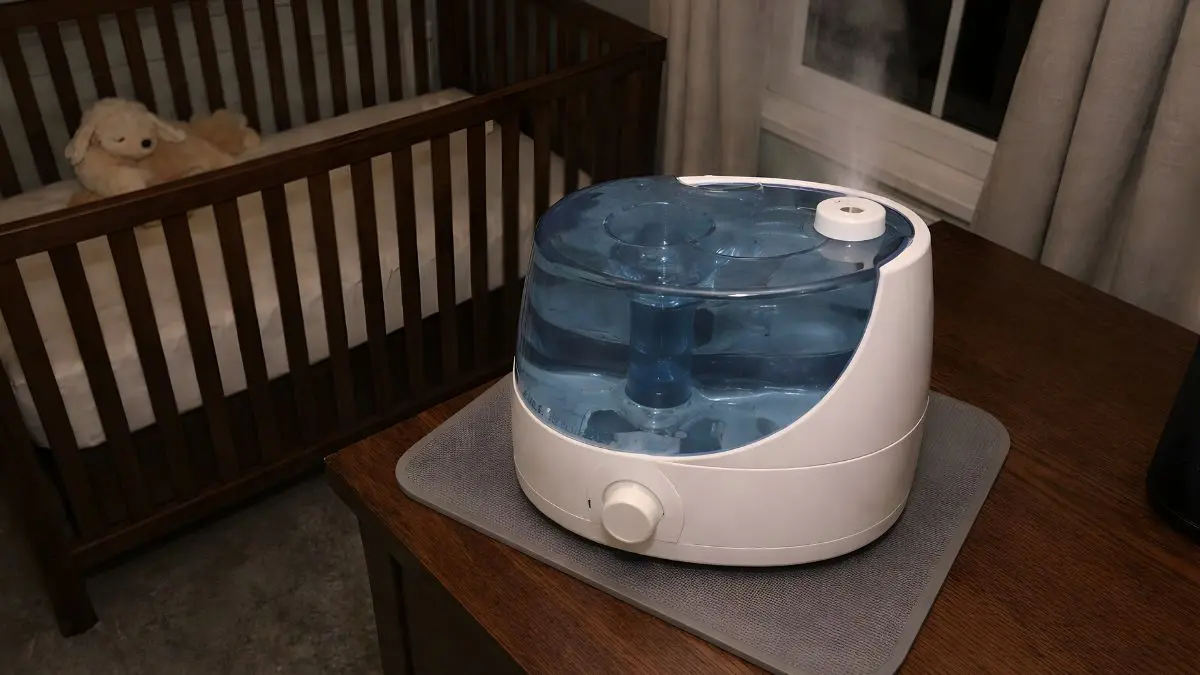
The surface should be level, stable, large enough to support the humidifier securely, and positioned so the baby cannot reach either the machine or its cord.
If possible, place the humidifier several feet away from the crib rather than directly beside it. This gives the mist more room to disperse through the nursery instead of concentrating moisture around the sleep area.
Keep the cord routed behind the furniture or secured so it cannot hang within reach of the crib.
If the dresser is wood, place a waterproof tray or manufacturer-approved protective mat underneath the humidifier to catch small drips during filling or cleaning.
2. A Dedicated Side Table Outside the Baby’s Reach
A small dedicated side table can work well when the main dresser is too close to the crib or already crowded with nursery equipment.
Choose a sturdy table that will not wobble or tip easily. Avoid lightweight folding tables, unstable stools, or furniture that can be pulled over by a crawling or standing child.
Position the table so the humidifier is not beside a power strip, baby monitor, charging station, or other electronics.
If the humidifier has an adjustable nozzle, point it toward the open center of the room instead of directly toward a wall, curtain, or the baby’s sleep surface.
3. A Stable Shelf or Surface on the Opposite Side of the Room
In a small nursery, the safest practical location may be on the opposite side of the room from the crib.
A stable shelf, console, or anchored piece of furniture can work well if the surface is large enough for the humidifier and the unit cannot be pulled down.
If you use a shelf or taller piece of furniture, make sure the furniture itself is secured according to its anti-tip instructions.
Do not place a heavy tank of water on top of unstable furniture simply to gain extra height.
The goal is to keep the humidifier safely out of reach while still allowing moisture to circulate throughout the nursery.
How Far Should a Humidifier Be From a Baby’s Crib?
There is no universal medical rule saying every humidifier must sit exactly three feet from every crib.
The more important safety rule is that the humidifier and its power cord must be completely out of the baby’s reach.
For corded nursery equipment, keeping cords at least three feet away from the crib and sleep space is a useful conservative safety rule.
For the humidifier itself, greater separation is often better if the mist can still circulate effectively through the room.
Do not position the unit where mist is visibly landing on the crib, mattress, wall, curtains, carpet, or nearby furniture.
Where Should You Point the Humidifier Mist?
Point the humidifier toward open room air.
You do not want a concentrated stream of cool mist aimed directly at the baby’s face, mattress, or bedding.
You should also avoid directing the nozzle toward:
- walls
- curtains
- wood furniture
- baby monitors
- outlets or power strips
- books or fabric storage
If you notice condensation, damp bedding, wet furniture, or moisture collecting on nearby surfaces, lower the mist setting or move the humidifier farther away.
Is a Humidifier Safe for Infants?
A humidifier safe for infants should be used with careful placement, cleaning, and humidity control.
Cool-mist humidifiers are generally considered the safer choice around babies and young children because they do not use hot water or steam that can cause burns if the unit is tipped or touched.
That does not mean every cool-mist humidifier is automatically safe.
You still need to keep the device and cord out of reach, prevent standing water, clean the humidifier regularly, and monitor the room’s humidity.
Ultrasonic humidifiers can also disperse minerals from tap water into the air as white dust. The EPA recommends using lower-mineral water, such as distilled water, when possible to reduce mineral buildup and mineral dispersal.
For a deeper breakdown, read our
Humidifier Safe for Infants Guide.
Pros and Cons of Humidifier in Baby Room
Understanding the pros and cons of humidifier in baby room setups helps you decide whether adding one is worth the extra maintenance.
The Pros
-
Helps relieve dry-air discomfort:
Added humidity can make dry indoor air feel more comfortable during heating season or when a child has congestion. -
Supports more comfortable sleep conditions:
Keeping room humidity in a moderate range may reduce dry nose, throat, and skin discomfort. -
Useful during winter:
Forced-air heating can make indoor air especially dry, so a humidifier can help restore moisture when humidity falls too low.
The Cons
-
Requires frequent cleaning:
Portable humidifiers need regular emptying, drying, and cleaning to prevent buildup inside the tank and base. -
Too much humidity creates problems:
Excess humidity and condensation can encourage mold growth and dust-mite activity. -
Ultrasonic models can create white dust:
Mineral-heavy tap water can leave deposits in the machine and disperse minerals into the room. -
Adds water near electronics:
A leaking or improperly positioned humidifier can damage furniture, flooring, monitors, chargers, and other nursery equipment.
What Makes a Baby Safe Room Humidifier?
A baby safe room humidifier should be easy to clean, stable on its surface, simple to refill, and easy to keep out of a child’s reach.
Useful features include:
- Cool-mist operation to avoid hot water and steam burn risks.
- Automatic shutoff when the tank runs dry.
- Easy-to-clean tank and base with accessible water-contact surfaces.
- Top-fill or easy-refill design to reduce spills during nightly use.
- Adjustable mist output so you can prevent condensation.
- Built-in humidistat or separate hygrometer to monitor room humidity.
I would not choose a nursery humidifier based only on mist output or tank size.
Cleaning access, stability, noise, controls, and the ability to manage humidity matter just as much.
Dad Test: Nursery Placement Checklist
- Surface: Stable, flat, hard, and water-resistant.
- Reach: Humidifier and power cord completely out of the baby’s reach.
- Mist: Directed into open room air instead of toward the crib or nearby surfaces.
- Humidity: Aim for roughly 30% to 50% relative humidity.
- Condensation: Reduce output if windows, walls, bedding, or furniture become damp.
Should a Humidifier Run All Night in a Baby Room?
A humidifier can run overnight if the room humidity stays in a reasonable range and the device is positioned and maintained correctly.
The EPA recommends keeping indoor humidity around 30% to 50%.
A separate digital hygrometer is useful if your humidifier does not accurately display room humidity.
If condensation forms on windows, walls, or nearby furniture, lower the output or turn the humidifier off.
A model with a humidistat can make overnight use easier because it can reduce or stop output after reaching the selected humidity target.
Frequently Asked Questions
Where to place humidifier in baby room?
Place the humidifier on a stable, flat, water-resistant surface outside the baby’s reach. Keep the power cord safely away from the crib and direct the mist toward open room air rather than the baby, bedding, walls, or electronics.
How far should a humidifier be from a baby’s crib?
Keep the humidifier and its cord completely out of reach. A three-foot minimum separation is a useful conservative rule for cord safety around a crib, while the humidifier itself can be farther away if the mist still circulates effectively through the nursery.
Should a humidifier run all night in a baby room?
It can run overnight if you monitor room humidity and prevent condensation. Aim for roughly 30% to 50% relative humidity and reduce the mist output if nearby surfaces become damp.
Can a humidifier cause a baby to cough?
A poorly maintained humidifier or excessive humidity can worsen indoor air quality. Dirty water, microbial growth, mineral dispersal, or excessive dampness may irritate sensitive airways. Keep the humidifier clean and monitor humidity rather than assuming more moisture is always better.
If coughing seems connected to humidifier use, see our
humidifier causing cough guide.
Where should I point the humidifier nozzle?
Point the nozzle toward open room air. Avoid directing concentrated mist at the crib, mattress, curtains, wall, electronics, or wood furniture.
Is a cool-mist humidifier safe for a baby?
Cool-mist humidifiers are generally considered safer around young children than warm-mist units because they do not contain hot water or produce steam that can cause burns. Safe use still requires proper placement, cleaning, humidity monitoring, and cord management.
-
HealthyChildren.org / American Academy of Pediatrics:
Guidance on cool-mist humidifiers and avoiding burn risks from hot water and steam around children. -
Environmental Protection Agency (EPA):
Guidance on humidifier cleaning, mineral buildup, water quality, and maintaining indoor humidity. -
U.S. Consumer Product Safety Commission (CPSC):
Cord-safety guidance for products used around cribs and infant sleep spaces.