
7 Rules: Is a Humidifier Safe for Infants in 2026?
Dadfficient is reader-supported. If you buy through my links, I may earn a commission at no extra cost to you. I only recommend gear that passes the “Dad Test.”
Is a humidifier safe for infants? You are standing in your baby’s nursery at 2:00 AM listening to them struggle with a dry, hacking cough. Your instinct is to immediately unbox that humidifier you received at the baby shower, fill it from the bathroom sink, and blast it on maximum.
I did exactly that with my first son, and it was a massive operational failure. I woke up to a soaked carpet, a false fire alarm triggered by mineral dust, and a baby who was still coughing.
If you are setting up a system to fight respiratory illness, you cannot afford to guess. Yes, a humidifier is safe for infants, but only if you use a cool-mist model, place it at least three feet away from the crib, and strictly monitor the tank for bacterial growth.
Here is the complete Dadfficient pillar guide to running a sterile, highly effective nursery environment.
Operator’s Summary: The 7 Core Rules
- Temperature Dictates Safety: Never use a warm mist vaporizer. Cool mist is the only AAP-approved option for infants.
- The Water Source: Standard tap water aerosolizes heavy minerals into a fine PM2.5 white dust. Distilled water or an evaporative wicking filter is mandatory.
- The 3-Foot Clearance: The unit and its power cord must remain a minimum of three feet away from the crib to prevent burn and strangulation hazards.
- Target the Sweet Spot: Aim for 40% to 50% relative humidity (RH). Anything over 60% turns the nursery into a breeding ground for dust mites and black mold.
- Zero Additives: Do not add essential oils or medicated vapor liquids to the tank for babies under two years old; it severely irritates developing airways.
- The 48-Hour Bio-Clock: Standing water grows Serratia marcescens (pink slime) in under two days. Empty and dry the tank daily.
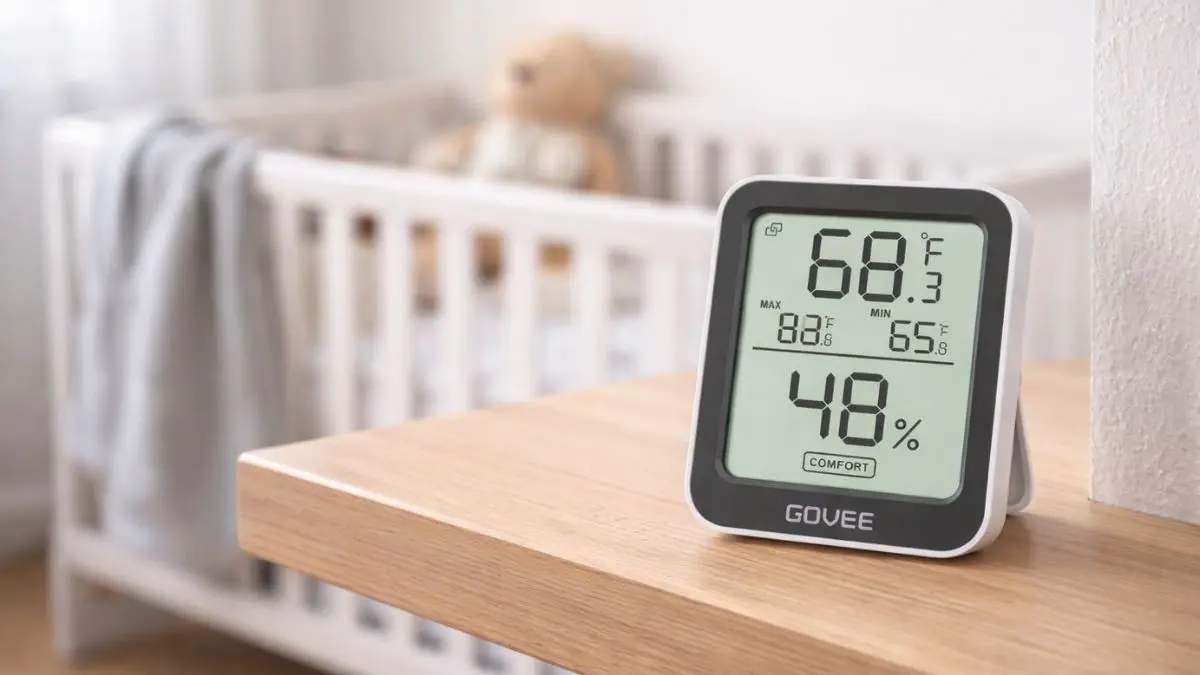
- Trust the Hygrometer: Built-in humidifier sensors are notoriously inaccurate. Use an independent digital hygrometer placed near the crib to track the actual moisture levels.
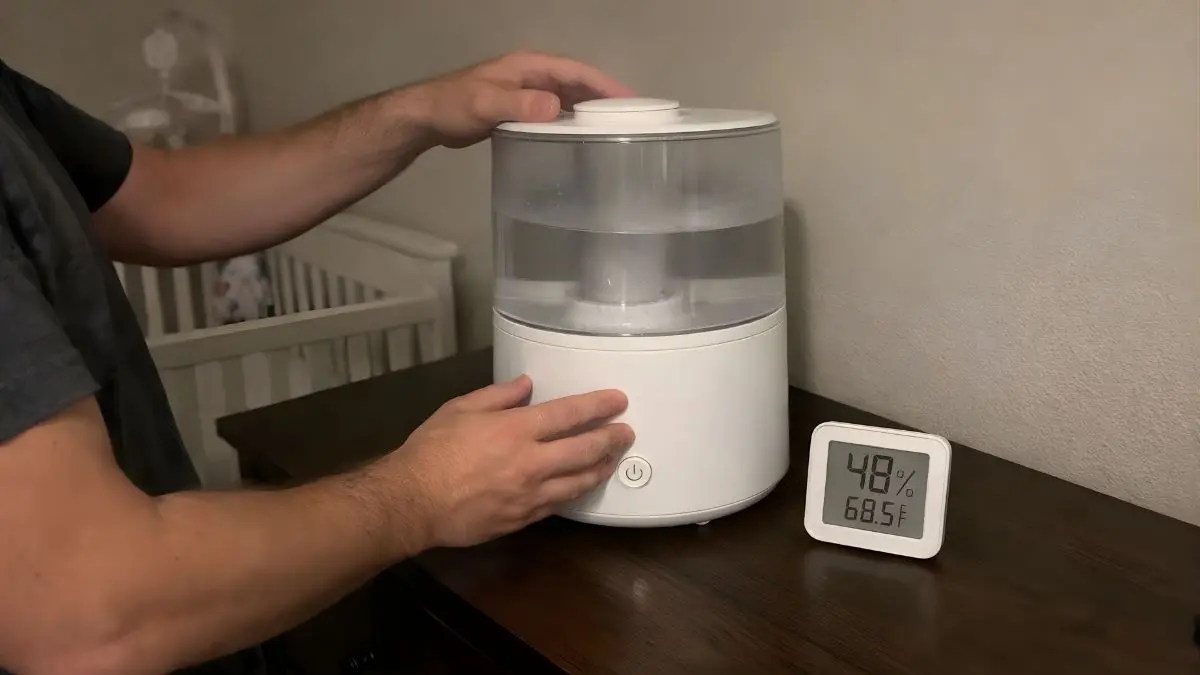
The Core Truth: Is a Humidifier Safe for Infants?
The hardware is safe, but the operator’s habits usually are not. When parents ask if a humidifier safe for infants is a real thing, the answer depends entirely on the technology selected.
The American Academy of Pediatrics (AAP) is explicitly clear: you must only use cool-mist humidifiers around children. Warm mist humidifiers (often called vaporizers) use an internal heating element to boil water into steam.
If a toddler manages to pull the power cord, or if you accidentally knock the unit off the nightstand in the dark, that boiling water poses a severe, immediate third-degree burn hazard.
Cool mist provides the exact same respiratory hydration without the thermal risk. The moisture thins the mucus, allowing the infant’s body to clear the airway naturally.
The Biological Mechanics: Using a Humidifier for Newborn Congestion
Infants are obligate nasal breathers. When they get their first cold, they cannot breathe through their mouths efficiently, and they certainly cannot blow their own noses.
When the winter air in your home drops below 30% relative humidity, the tiny hair-like structures in your baby’s respiratory tract (cilia) dry out and become paralyzed. The mucus hardens like cement.
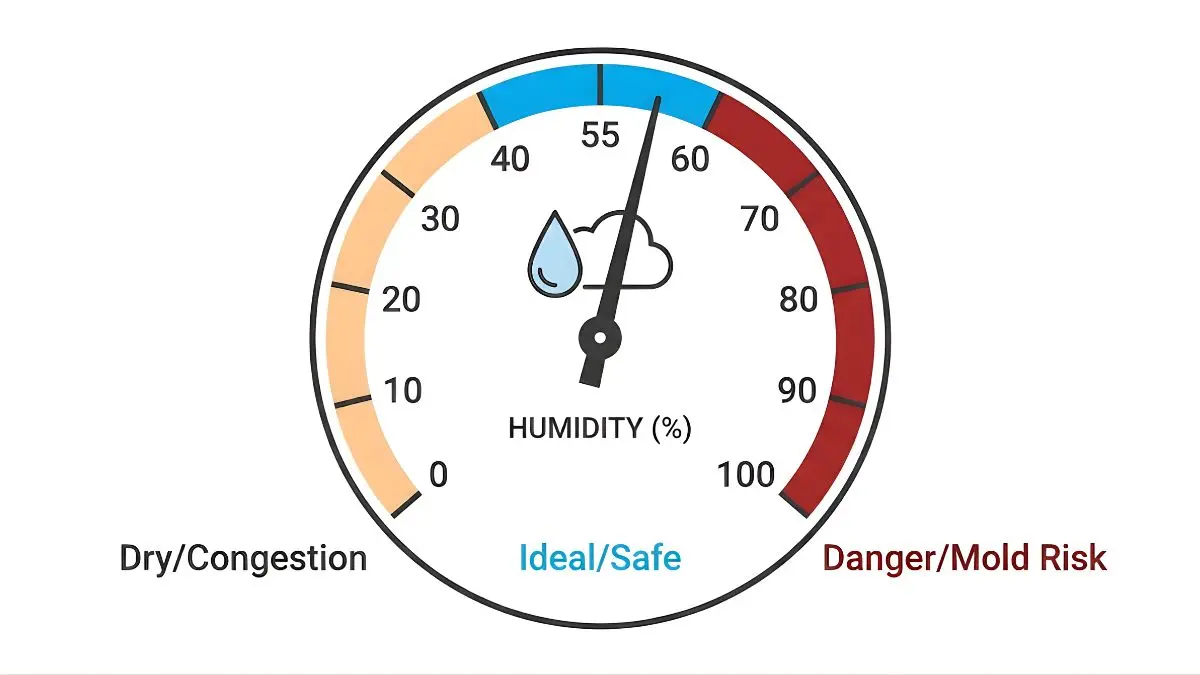
Using a humidifier for newborn congestion works by mechanically rehydrating those cilia. By pushing the room’s humidity into the 40% to 50% target zone, the mucus thins out, the cilia resume sweeping the pathogens out of the lungs, and the baby stops waking up with a hacking cough.
It is simple biology supported by proper environmental controls.
Top 4 Nursery Hazards (And How to Eliminate Them)
When utilizing a humidifier for baby cough and cold symptoms, you introduce standing water and electricity into a sleeping environment. You must actively manage the resulting hazards.
1. The “White Dust” Threat
If you fill a cheap ultrasonic humidifier with tap water, the rapidly vibrating ceramic transducer shatters the water—and all the dissolved minerals inside it—into microscopic droplets. When those droplets evaporate in the air, calcium and magnesium are left floating as PM2.5 particulate matter.
This white dust settles on your baby’s crib and is inhaled with every breath, often acting as a severe respiratory irritant that makes the cough worse.
The Fix: Run the unit strictly with distilled water, or upgrade to an evaporative humidifier that traps minerals inside a paper wicking filter.
Read more: Is Humidifier White Dust Harmful in 2026?
2. The Mold and Biofilm Trap
Humidifiers are dark, damp, and warm. If you leave stagnant water in the tank, a pink bacteria called Serratia marcescens will form a slimy ring along the base in less than 48 hours. Turning that machine on aerosolizes the bacteria directly into the nursery, causing “humidifier fever”.
The Fix: Implement a daily “dump and dry” routine. Every morning, empty the tank completely and leave the cap off so it air dries. Clean the base weekly.
Read more: How to Clean Humidifier with Hydrogen Peroxide
3. The Swamp Effect (Over-Humidification)
More is not better. If you close the nursery door and crank the machine to “High,” the relative humidity will quickly spike past 60%. The EPA states that indoor humidity above this threshold triggers aggressive dust mite reproduction and black mold growth inside the drywall.

The Fix: Place a standalone $10 digital hygrometer across the room from the humidifier. If it reads 50%, turn the humidifier off immediately.
Read more: Best Humidity Level for Sleeping When Sick
4. Ecosystem Conflicts
If you have a smart air purifier running in the nursery, an ultrasonic humidifier will cause a massive ecosystem conflict. The purifier’s PM2.5 laser sensor will read the airborne water droplets as severe smoke pollution. The purifier will ramp up to 100% fan speed, creating a wind tunnel while the baby is trying to sleep.
The Fix: Separate the devices on opposite sides of the room, or switch to an evaporative humidifier which releases water as an invisible gas that the laser sensor ignores.
The Blueprint: Where to Place Humidifier for Baby
Figuring out where to place humidifier for baby safety is a non-negotiable step. Placing it on the floor next to the crib guarantees water damage to your carpets and creates a severe strangulation risk with the power cord.
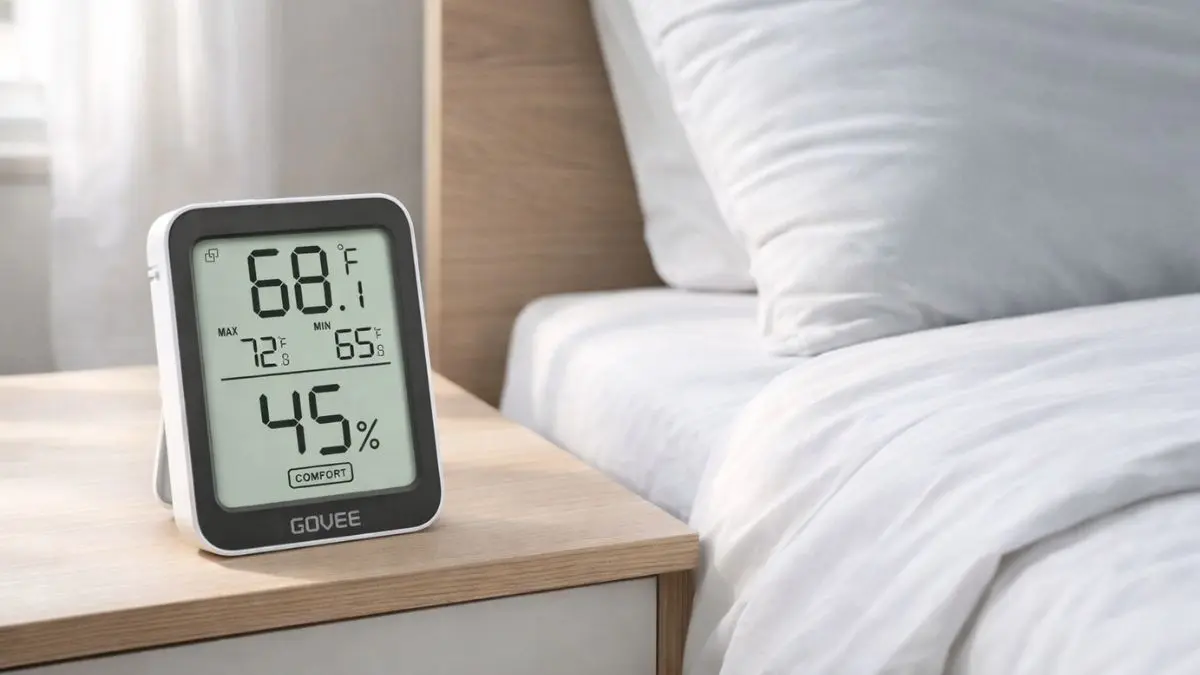
- The 3-Foot Rule: Maintain a minimum three-foot radius between the humidifier, the power cord, and the crib.
- Height is Mandatory: Place the unit on top of a water-resistant dresser or a dedicated end table. Elevating the machine allows the mist to absorb into the ambient air before gravity pulls it down to the floor.
- Trajectory Control: Point the mist nozzle toward the open center of the room. Do not point it directly at the baby, the walls, or the curtains, which will cause dampness and mildew.
Dad Test Metrics: Choosing the Right Gear
If you want a truly humidifier safe for infants setup that requires zero distilled water runs to the grocery store, you need an evaporative unit. The Canopy Humidifier traps all minerals and bacteria in a disposable paper filter, emitting only pure, invisible hydration.
Dad Test Metrics: Canopy Evaporative Humidifier
- Install Ease: 9/10 (Drop the filter in, fill the tank from the tap, and plug it in).
- WAF (Wife Acceptance Factor): 10/10 (Dishwasher safe parts and zero white dust on the nursery furniture).
- Toddler-Proof: 8/10 (No hot steam or vibrating plates, totally safe to touch).
- Reliability: 9/10 (Internal UV sensors prevent mold growth automatically).
Troubleshooting the Nursery Setup
If you are already running a machine and running into operational failures, here are the fast Dadfficient fixes to get your nursery back online:
If your Levoit unit is dead: Read the Levoit Humidifier Red Light Fix to unstick the internal float valve.
If the mist stops completely: Follow the 5 steps in my Levoit Humidifier Not Misting guide to dissolve hard water scale off the transducer.
If the unit sounds like a lawnmower: Execute the fan alignment check in 4 Proven Fixes for a Vicks Humidifier Making Noise.
If your nightstand is a puddle: Secure the O-ring seals using the Portable Humidifier Leaking From the Bottom checklist.
If the cough is getting worse: You likely have biological growth. Read 4 Proven Fixes For a Humidifier Causing Cough to sterilize the tank immediately.
Frequently Asked Questions (FAQ)
Is using a humidifier for newborn congestion actually effective?
Yes, using a humidifier for newborn congestion is highly effective. Because infants are obligate nasal breathers, a stuffed nose prevents them from eating and sleeping. Maintaining 40% to 50% relative humidity in the room hydrates their nasal passages, naturally thinning the mucus so their bodies can clear the airway.
What kind of humidifier for baby cough and cold should I buy?
The AAP explicitly recommends a cool-mist humidifier (either ultrasonic or evaporative) for an infant’s room. You must never use a warm-mist vaporizer due to the severe scalding risk associated with boiling water in a child’s environment.
Exactly where to place humidifier for baby safety?
You should place the humidifier on a raised, water-resistant surface like a dresser, ensuring both the machine and its power cord are at least three feet away from the crib. Point the mist toward the open center of the room to prevent condensation from soaking the baby’s bedding or the adjacent walls.
- American Academy of Pediatrics (AAP): Verified guidelines prohibiting the use of warm mist vaporizers around infants due to thermal burn risks.
- Environmental Protection Agency (EPA): Verified standard operational metrics for indoor relative humidity (30-50%) to stunt dust mite and mold proliferation.