Best Small Air Purifier for Office: 3 Picks (2026)
By Dadfficient
Dadfficient is reader-supported. When you buy through our links, we may earn an affiliate commission at no extra cost to you.
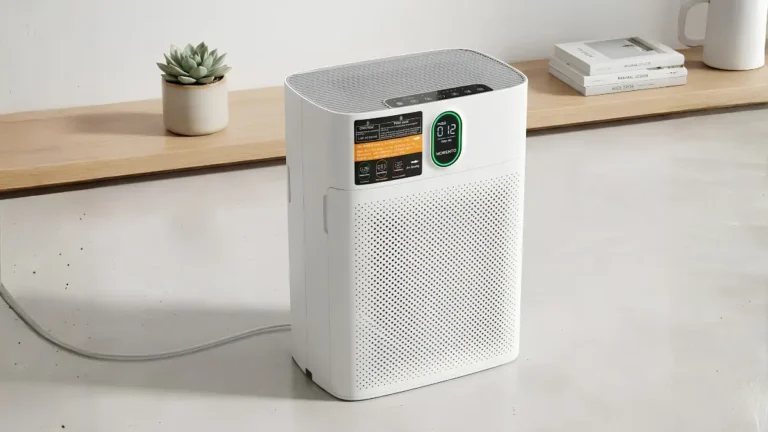
Finding the right small air purifier for office use comes down to airflow, noise and how much workspace you can actually give up. Based on published CADR, manufacturer room-size guidance, manuals and practical office use, the Blueair Blue Pure 511i Max is our best overall pick for a closed private office.
The smaller Blueair Mini Max makes more sense beside a monitor or inside a cubicle, while the Levoit Core Mini-P is the budget choice for a very small personal workspace. The mistake is expecting a tiny desktop purifier to clean an entire open-plan office.
Dadfficient has not physically tested these three units. This guide compares current manufacturer specifications, manuals, EPA air-cleaner guidance and practical ownership factors to identify which size makes the most sense for a private office, desk or cubicle.
- Best Overall: Blueair Blue Pure 511i Max — enough published airflow for an actual small private office, plus Auto Mode, PM2.5 sensing and scheduling.
- Best for Desk / Cubicle: Blueair Blue Pure Mini Max — only 6.8 inches wide and better matched to localized workspace use.
- Best Budget: Levoit Core Mini-P — compact and low-power, but its 34 CFM CADR limits it to very small spaces.
Quick Pick: Best Small Air Purifier for Office Use
| Product | Best For | Smoke CADR | Room Size at 4.8 ACH | Noise | Width | Link |
|---|---|---|---|---|---|---|
| Blueair 511i Max | Best Overall | 153 CFM | 237 sq. ft. | 19–48 dB | 9.3″ |
Check Price ➜ |
| Blueair Mini Max | Best for Desk | 69 CFM | 107 sq. ft. | 19–44 dB | 6.8″ |
Check Price ➜ |
| Levoit Core Mini-P | Best Budget | 34 CFM | 53 sq. ft. | 25–44 dB | 6.5″ |
Check Price ➜ |
Best Overall: Blueair Blue Pure 511i Max
For the best air purifier for small office use, the 511i Max has the strongest whole-room case of these three models. Blueair currently publishes a 153 CFM smoke CADR and recommends it for roughly 237 square feet at 4.8 air changes per hour.
That is enough airflow for many closed 10×12, 12×12 and similarly sized offices without forcing you into a large floor-standing purifier. Its 9.3-inch footprint is still compact, although it makes more sense on a side table, cabinet or floor than taking up prime desk space.
Why It Makes More Sense for a Private Office
The 511i Max adds a PM2.5 sensor, Auto Mode, Night Mode, app control and scheduling. That matters at work because you can schedule higher airflow before arriving, let Auto Mode take over during the day and reduce unnecessary runtime after hours.
Blueair’s RealTrack system also estimates filter life using operating conditions rather than relying only on a fixed calendar. Blueair says users should generally expect about six to nine months from the main filter.
One Blueair Detail You Should Know
Blueair’s HEPASilent system is not purely mechanical filtration. Blueair says it combines mechanical filtration with an electrostatic stage that charges particles inside the purifier so they adhere more easily to the filter media.
Blueair does not provide a separate user control to switch that electrostatic stage off. The company says its purifiers comply with applicable ozone-emission requirements, but buyers who specifically want mechanical-only filtration may prefer a different design.
Best for Desk/Cubicle: Blueair Blue Pure Mini Max
If you’re looking for a small air purifier for office cubicle use, the Mini Max is the cleaner physical fit. It is only 6.8 inches wide, weighs about 2.8 pounds and publishes a 69 CFM smoke CADR.
Blueair rates it for about 107 square feet at 4.8 ACH. That makes it far more believable as a compact cubicle or small personal-office purifier than extremely low-airflow USB gadgets.
Simple Controls Can Be an Advantage
Unlike the 511i Max, the standard Mini Max has no Wi-Fi app, PM2.5 sensor or Auto Mode. You get straightforward manual fan-speed controls.
That can actually be useful in a corporate environment where you do not want another Wi-Fi device connected to a company network.
Don’t Expect It to Clean an Open Office
As a small air purifier for office desk or cubicle use, 69 CFM is useful—but it is still not enough for an entire open-plan floor. Keep the Mini Max reasonably close to your workstation and think of it as a purifier for your immediate work area.
Blueair says the Mini Max replacement filter can last up to nine months depending on usage. That makes filter cost worth checking before assuming the smallest purifier will automatically be the cheapest one to own.
Best Budget: Levoit Core Mini-P
The Levoit Core Mini-P is the lowest-cost option in this group and takes up only a 6.5-inch circle of desk space. Levoit publishes a 34 CFM CADR, 7-watt rated power draw and a 25–44 dB operating range.
The important number is the CADR. At 4.8 ACH, Levoit rates the Core Mini-P for only about 53 square feet. That makes it a personal-workspace purifier, not a realistic whole-room solution for a normal private office.
What the Core Mini-P Actually Filters
Levoit currently describes the Core Mini-P as using 3-stage filtration with a pre-filter, main particle filter and activated-carbon layer. Its published CADR and tiny footprint are more useful buying signals than relying on a single filtration label.
The built-in aroma pad can also hold essential oil, but treat that as a small bonus rather than an odor-control system. The Core Mini-P does not contain enough carbon media or airflow to solve a persistent office odor problem by itself.
The Filter Light Is a Reminder, Not an Air-Quality Sensor
Levoit’s manual says the filter indicator typically illuminates after roughly four to six months depending on usage. It is a maintenance reminder, not a PM2.5 sensor telling you the filter is physically dirty.
After changing the filter, keep the purifier plugged in with the fan off and hold the control button for three seconds. The indicator should blink three times and switch off when the reset succeeds.
What Size Air Purifier Does a Small Office Actually Need?
Choosing a small air purifier for office use starts with CADR and air changes per hour. CADR tells you how much particle-free air the purifier can deliver, while ACH tells you how often that clean-air volume can cycle through the room.
For a typical office with an 8-foot ceiling, a 150-square-foot room needs roughly 100 CFM to approach five air changes per hour. A 250-square-foot room needs closer to 160 CFM.
That is why room-size marketing based on one air change per hour can be misleading. A purifier may technically affect a much larger room, but it will clean that room far more slowly.
Need More Airflow Than a Desktop Purifier?
If your office is larger than the Mini Max or Core Mini-P can reasonably cover, move up instead of forcing a tiny purifier to do whole-room work. The Levoit Core 300S-P is a stronger step-up option with a published 141 CFM CADR and coverage of roughly 219 square feet at 4.8 ACH.
If you need to compare larger whole-room models, our guide to the best air purifiers of 2026 covers higher-output options without pushing you into oversized commercial equipment.
Do Mini Desk Air Purifiers Actually Work?
A small air purifier for office desk use can work, but only when expectations match the airflow. A real mini purifier with a published CADR can remove airborne particles from a small area, especially when it sits reasonably close to your workstation.
It cannot turn one cubicle into a sealed clean room or clean an entire open-plan office. EPA guidance emphasizes matching CADR to the actual room or area being served.
This is why we would skip novelty USB purifiers that do not publish meaningful airflow data. Small size is useful; unknown airflow is not.
Office Desk vs Cubicle vs Small Private Office
The right small air purifier for office use depends heavily on whether you are cleaning a desk zone, a cubicle or an enclosed room.
For a crowded air purifier for office desk setup, the Blueair Mini Max gives you the best balance of footprint and meaningful airflow in this group. It is still small enough to fit beside a monitor without consuming half the desk.
For an air purifier for office cubicle setup, the same logic applies: prioritize a compact footprint and published airflow rather than buying the smallest purifier you can find.
The Core Mini-P makes more sense when price and space matter more than room coverage. Its 34 CFM CADR is best treated as close-range personal filtration.
A closed private office changes the equation. The Blueair 511i Max has enough airflow to work as an actual room purifier rather than just a desk accessory.
3 Office Air Purifier Mistakes to Avoid
The original version of this guide focused entirely on common office mistakes. Those problems still matter, but they make more sense after you understand how much airflow your workspace actually needs.
Mistake 1: Treating a Desktop Purifier Like a Whole-Room Machine
The biggest mistake with a small air purifier for office use is assuming that every compact unit can clean the entire room. A 34 CFM purifier and a 153 CFM purifier may both fit beside a desk, but they are doing very different amounts of work.
Use the manufacturer’s CADR and realistic ACH coverage instead of assuming that physical size tells you how powerful the purifier is.
Mistake 2: Blocking the Intake or Exhaust
Desk placement matters because a purifier still needs open space to pull dirty air in and push cleaned air back out. Placing one directly against a wall, behind a stack of files or under a desk can restrict airflow.
Follow the clearance guidance for the specific model rather than using one universal placement distance for every purifier.
Mistake 3: Buying for Silence Instead of Usable Airflow
Low noise is important around coworkers and video calls, but the quietest setting is not automatically the best setting. Fan speed and airflow are connected, so running an undersized purifier on its lowest setting may produce very little useful clean-air delivery.
A better approach is choosing a purifier with enough capacity that you do not have to run it at maximum speed all day.

A Stuffy Office Is Not Always an Air-Purifier Problem
Even the best small air purifier for office use will not fix every indoor-air problem. If your office feels stale after several people have been sitting inside with the door closed, poor ventilation may be the real issue.
Particle filters do not replace ventilation and do not remove the carbon dioxide produced by occupants. EPA treats portable filtration as a supplement to source control and ventilation, so the fix may involve bringing in outdoor air or improving the building’s HVAC operation rather than buying a larger purifier.
Noise Matters More When the Purifier Sits Beside You
When choosing a small air purifier for office use, noise matters more when the unit sits only a few feet from your chair. A purifier operating three feet from your workstation is more noticeable than the same machine sitting across a bedroom.
The 511i Max is rated at 19–48 dB, the Mini Max at 19–44 dB and the Core Mini-P at 25–44 dB. Lower fan speeds will be easier to live with during calls, but lower speed also means less air being filtered.
If acoustic discretion is a priority, our quietest air purifier guide explains how noise and airflow interact, and the same principles apply to office use.
HEPA, CADR and Filter Cost: What Actually Matters?
When comparing a small air purifier for office use, do not shop on the word “HEPA” alone. CADR gives you a better picture of how quickly the complete purifier can deliver cleaned air into the room.
Filtration design still matters, but so does replacement cost. Blueair’s 511i Max uses RealTrack and generally expects six to nine months of filter life. Blueair says the Mini Max filter can last up to nine months depending on use, while Levoit’s Core Mini-P manual recommends replacement roughly every four to six months.
None of these compact models should be treated as heavy-duty VOC or odor machines. EPA notes that gas removal depends heavily on the amount of activated carbon or other sorbent material in the filter.
If you want to compare the manufacturers before choosing a specific model, our best air purifier brands guide breaks down how Blueair, Levoit, Coway and other major brands differ.
Final Verdict
If you want the best small air purifier for office use in a normal closed private room, buy the Blueair Blue Pure 511i Max. Its higher CADR, Auto Mode, PM2.5 sensor, schedules and RealTrack filter monitoring justify the step up.
Buy the Blueair Mini Max if your purifier needs to live on a desk or inside a cubicle. It gives you more meaningful airflow than the Core Mini-P without taking up much more space.
Buy the Levoit Core Mini-P when upfront price and footprint matter most. Just understand that its 34 CFM output puts it firmly in personal-space territory.
Frequently Asked Questions
What is the best small air purifier for office use?
For most closed private rooms, our top small air purifier for office pick is the Blueair Blue Pure 511i Max because it combines a 153 CFM published smoke CADR with a compact footprint, PM2.5 sensing, Auto Mode and scheduling.
Do air purifiers work in office cubicles?
Yes, but a small cubicle purifier should be treated as localized filtration. A compact unit can clean air around your immediate workspace, but it will not purify an entire open-plan commercial floor.
Can I put an air purifier on my office desk?
Yes. A compact model such as the Blueair Mini Max or Levoit Core Mini-P can sit on a desk as long as its intake and exhaust remain unobstructed.
Is a mini air purifier for desk use effective?
A mini air purifier for desk use can be effective when the model publishes meaningful CADR and is used for a small personal workspace. It should not be expected to replace a properly sized whole-room purifier.
How much clearance does the Levoit Core Mini-P need?
Levoit’s current manual says to leave approximately 15 inches of clearance on all sides of the Core Mini-P so airflow is not restricted.
What size air purifier do I need for a small office?
A typical 150-square-foot office with an 8-foot ceiling needs roughly 100 CFM to approach five air changes per hour. Around 250 square feet requires closer to 160 CFM, so check CADR instead of relying only on maximum room-size marketing.
Does an office air purifier reduce CO2?
A normal particle air purifier does not solve elevated carbon dioxide caused by poor ventilation. If CO2 or stale occupied air is the problem, ventilation or HVAC changes are needed.
What is Blueair HEPASilent?
Blueair says HEPASilent combines mechanical filtration with electrostatic charging inside the purifier. The charged particles are then captured by the filter media.
How often does the Levoit Core Mini-P filter need replacing?
Levoit’s current manual recommends roughly every four to six months, although actual life depends on usage and pollution levels. The check-filter indicator is a maintenance reminder rather than a real-time dirt sensor.
-
Blueair — Blue Pure 511i Max specifications, room size and smart features
-
Blueair — Blue Pure Mini Max specifications and filtration design
-
Blueair Support — HEPASilent filtration information
-
Levoit — Core Mini-P specifications and filtration
-
Levoit Core Mini-P User Manual — filter maintenance, reset procedure and clearance guidance
-
Levoit — Core 300S-P specifications
-
U.S. EPA — Air cleaner sizing, filtration and ventilation guidance